Diverse and comprehensive code covers global Balqzaiah and highlight them in all respects to satisfy the reader and the viewer primarily to be good when the Arab citizen in the first place, wherever found and thank you for your brother Taatbekm Alstreeta age =========

This is default featured slide 1 title

Go to Blogger edit html and find these sentences.Now replace these sentences with your own descriptions.This theme is Bloggerized by Lasantha Bandara - Premiumbloggertemplates.com.

This is default featured slide 2 title

Go to Blogger edit html and find these sentences.Now replace these sentences with your own descriptions.This theme is Bloggerized by Lasantha Bandara - Premiumbloggertemplates.com.

This is default featured slide 3 title

Go to Blogger edit html and find these sentences.Now replace these sentences with your own descriptions.This theme is Bloggerized by Lasantha Bandara - Premiumbloggertemplates.com.

This is default featured slide 4 title

Go to Blogger edit html and find these sentences.Now replace these sentences with your own descriptions.This theme is Bloggerized by Lasantha Bandara - Premiumbloggertemplates.com.

This is default featured slide 5 title

Go to Blogger edit html and find these sentences.Now replace these sentences with your own descriptions.This theme is Bloggerized by Lasantha Bandara - Premiumbloggertemplates.com.

‏إظهار الرسائل ذات التسميات World of the Internet. إظهار كافة الرسائل

السبت، 12 سبتمبر 2015

Jimmy Kimmel Hands People First Generation iPhone And Tells Them It's The New iPhone 6S

Jimmy Kimmel Hands People First Generation iPhone And Tells Them It's The
.source==G==ew iPhone 6S

الجمعة، 11 سبتمبر 2015

Windows 10 is sneaking onto Windows 7 and 8 installs without permission

Windows7 7232
Microsoft is downloading Windows 10 to Windows 7 and 8 machines, even if the user hasn’t expressed permission. A reader of The Inquirer saw that the ~BT Windows 10 folder had appeared on his system even though he hadn’t reserved a copy. He only noticed after spotting a number of failed ‘Upgrade to Windows 10’ messages in his Windows Update history. Microsoft has confirmed this is happening to The Inquirer, as well as VentureBeat and PCWorld when reached for a statement.
Users have been able to opt-in to the free Windows 10 upgrade if they're running Windows 7 or 8, but apparently even if they don't, the files are being downloaded anyway. It's happening on devices which have automatic updates allowed, which we'd generally recommend to catch the latest security and stability updates for Windows.
When asked about this issue, Microsoft responded by saying “For individuals who have chosen to receive automatic updates through Windows Update, we help upgradable devices get ready for Windows 10 by downloading the files they’ll need if they decide to upgrade. When the upgrade is ready, the customer will be prompted to install Windows 10 on the device.” Convenient, if you're installing Windows 7 or 8 specifically to upgrade to Windows 10. Otherwise, not so much.
The automatic download takes up between 3.5 and 6GB of storage space, which may not sound like a lot, but it’s not an insignificant amount for some users. Windows tablets with smaller hard drives are affected, and people with data caps on their Internet connections certainly don’t want that amount of data coming in without permission. The background download could affect people with poor Internet connections too, without them being aware that they're downloading unnecessary files.
Since launch, over 75 million devices have made the upgrade to Windows 10, and some sources say that the number is closer to 100 million.Source===pcgamer

الخميس، 10 سبتمبر 2015

The Apple iPad Pro event: A good, sad day for Microsoft

Technically Incorrect offers a slightly twisted take on the tech that's taken over our lives.

pencil5.jpg
But it's nothing like a stylus, right? CNET
The graybeards who've adored Apple ever since Steve Jobs was a lad must have looked at this and winced.
Or might they have thought it the ultimate in scalding irony?
Here was Kirk Koenigsbauer, corporate vice president for Microsoft's Office division, wandering onto the stage of an Apple event. Not because he had lost his temper and wanted to berate Apple CEO Tim Cook, but because there's now a certain level of nice (and need) between the two companies.
Think, though, what he and his company had to endure on Wednesday. Koenigsbauer was at the event to discuss the role Microsoft Office plays on Apple's new 12.9-inch iPad Pro, which when you put all the pieces together might pass as a lookalike for the Microsoft Surface at a casting session.
There, too, was Apple lauding the same thing of which Cook had once said, "Our competition is confused. They're turning tablets into PCs and PCs into tablets."
Those clouds of confusion parted more quickly than a shower on a December day in St. Lucia. Suddenly, it all makes sense and it all looks good. Apple good.
As if, though, to apply a touch of albumen foundation before adding a little yolk mascara to Redmond's face, Apple produced a stylus.
"Who wants a stylus?" Jobs famously said at Macworld in 2007. "You have to get them and put them away and you lose them. Yeuch. Nobody wants a stylus."
Of course, Apple didn't present a stylus on Wednesday. It presented the Apple Pencil. Pencils are cool, you see. They're human. Styluses are chilly and nerdy.
It's not enough having stylus, ya gotta have style.
And there's the essence of Microsoft's cheery melancholy today. As many learn in life, being right often gets you nowhere. "That was my idea" may be honest words that some never get over.
How much worse it will be for some at Redmond if the iPad Pro is a big-screen success. How much worse if it eclipses the Surface Pro.
At the heart of it all, though, is brand.
Where Microsoft once understood that people needed to feel positively about its name and ethos, somehow Bill Gates and then Steve Ballmer let that go in favor of power, dominance and ubiquity.
Where they could have continued an ad campaign such as "Where Do You Want To Go Today?" that put people, hearts and dreams at its core, they forced Windows onto the world's laptops. Not enough people loved Microsoft for it.
Meanwhile, Apple mocked Redmond and became loved. The Mac vs. PC campaign was a manifesto for the identity that those who used Macs wanted to be associated with. It was something for them to feel a part of. It lasted and it worked. It lasted because it worked.
When Microsoft launched Surface, it had an avowedly different-looking product in its hands. It presented this product through some of the most painful advertising ever seen. You surely remember the dancing teens? Oh, they still haunt you?
The Surface product has improved, as have its sales. Microsoft had a three-year head start. But now it must watch Apple's reinterpretation of some of its ideas and wonder whether there's any justice in the world.
There's rarely justice. The best you can hope for is poetry.
In 2012, cartoonist (current project Sharksplode), writer and voice actor Joel Watson predicted that Apple would launch a Surface-like thing in 2015. He has cartoon Steve Ballmer holding a Surface and uttering these words: "In three years when Apple copies this, you cockwads will think it's genius."
2012-06-19-surface-tension.jpg
This was created in 2012 by Joel Watson, who makes online comics and is a voice actor for Cyanide and Happiness. Hijinksensue.com (With Permission.)
The excellent part for anyone at Microsoft must be that it employs people who do see the future and see it clearly. The galling part must lie in seeing Apple potentially gaining the most from that vision.
So many deep, rational, righteous thinkers decry Cupertino for its alleged distortion field and the supposed reliance on that deadly nonsense known as marketing. But the company has always stopped to think about how to delight humans. This doesn't mean it always gets it right. It does mean that it goes out of its way to try.
How Microsoft wished it had found a way to be held to human bosoms, rather than be kept at arm's length.
Of course, it could be that the iPad Pro will be a failure. I fancy, though, that aside of its more rational business uses, there will be plenty of people who will be only too delighted to be seen with the vast new Apple screen.
In some bars around Washington state on Wednesday night, there will have been more than a few muttering into their glasses of fizzy rosé: "Apple Pencil, my a**."Source===cnet

الثلاثاء، 8 سبتمبر 2015

50 Million Dollar Disappearing Garage

You might think you’ve got the ultimate garage, but do you have one with a subterranean storage lair?
Check out this Lake Tahoe estate with a massive 30 car underground garage that’s accessed by way of a massive hydraulic lift! Well it only costs $50 million!Source==youtube===

Nokia C1 Android smartphone concept emerges

Nokia is getting back into the smartphone game, and these images — initially believed to have been real leaked pictures of Nokia's prototype — show one fan's concept for how to reintroduce the brand to phone buyers. Earlier this summer, Nokia CEO Rajeev Suri said that the Finnish company will indeed look to make a return, by designing and licensing handsets, to the mobile market once its agreement with Microsoft to not use the Nokia name on smartphones had expired. Having been barred from branding any smartphones as Nokias until the end of 2015, the company is now working on its plans for 2016 and beyond, which it has said will not conflict with Microsoft's mobile efforts: "Microsoft makes mobile phones. We would simply design them and then make the brand name available to license."
The concept Nokia C1 would run run on Android Marshmallow, powered by an Intel Atom processor inside. Its proposed 5-inch size and 1080p resolution are both rather conventional, and the suggestion is that Nokia should aim for a budget-friendly device.
The Nokia N1 tablet, introduced earlier this year, sets the likely blueprint for what we can expect from its next mobile device. The N1 was manufactured and distributed by Foxconn, which licensed Nokia's design and brand. There's no guarantee that Foxconn will again be the partner for any new smartphone projects, though given the two companies' established collaboration, it would seem to be a probable candidate. If Nokia does decide to develop an Android smartphone, it wouldn't be its first one ever — that was the Nokia X — though it would be the first without Microsoft's influence and control.
Update September 8th 8:33AM ET: It appears that these pictures are the product of a Nokia fan's imagination rather than prototypes from the Finnish company. They were originally posted by Kim Wayne, who also presented an earlier set of renders of the purported C1.Source==THE VERGE====

GoPro's Google-Powered Camera Is the Next Best Thing To Teleportation

GoPro's Google-Powered Camera Is the Next Best Thing To Teleportation
This year, the most amazing thing I saw at Google’s annual developer conference wasn’t a phone, a tablet, or even a head-mounted display. It was a 360-degree 3D video that took me to Japan. Now, filmmakers can spend $15,000 on the tech that made it possible: the GoPro Odyssey. It’s one heck of a camera.
Okay, so I probably need to do a little explaining: the GoPro Odyssey isn’t a camera in the traditional sense. It’s actually an array of 16 perfectly aligned GoPro Hero4 Black cameras—the same $500 ones you’d mount on your surfboard or drone or mountain bike—plus some special Google hardware and software to combine them into a single 360-degree stereoscopic 3D video at 8K resolution and 30 frames per second. (It’s an incredible amount of data.)
GoPro's Google-Powered Camera Is the Next Best Thing To Teleportation
What Odyssey looks like now. The top image in this post is what it looked like back in May.
The result is a video like nothing you’ve ever seen. You place your smartphone into a Google Cardboard VR headset, put it up to your face, and you’re somewhere else. A beach. A glacier. A cable car climbing up a Japanese mountain filled with sightseers like yourself. And the quality is far better than any other such 360-degree video I’ve seen, due to the way Google’s software computationally generates believable 3D no matter where you turn your head. No seams. With this camera, filmmakers could take you to all sorts of wonderful places.
GoPro's Google-Powered Camera Is the Next Best Thing To Teleportation
You don’t technically need to buy a $15,000 GoPro rig to create such a video: Google’s initative, dubbed Jump, will actually let you 3D-print a frame to install your own cameras. But the GoPro Odyssey kit doesn’t just come with 16 cameras (and 16 cables, and 16 microSD cards, and... you get the picture) it’s also got the hardware to interface all of them together, custom firmware loaded onto the cameras, and a way to plug ‘em all into an AC outlet simultaneously—so you don’t need to swap out 16 batteries in the middle of a shoot.
GoPro claims Odyssey allows the 16 Hero4 Black units to act like a single camera, with every pixel of every frame synced accurately.
Plus—since GoPro is Google’s primary partner—this is probably the only way you get access to Google’s super-impressive Jump video assembler technology for a while. Speaking of getting access, though, it may be rather limited to start: GoPro and Google are accepting applications now, but will only give “select content partners” the go-ahead to actually buy one.
In the meanwhile, there’s already a way for you to see what this camera is capable of: just direct your Chrome browser or the YouTube app on your phone to this video:
Be sure to tap and drag (or move your phone) to pan around. Or put on a Google Cardboard headset for the best results.
What if you aren’t a pro, yet you still like the idea of creating virtual reality videos? You could try a Ricoh Theta, which will let you publish non-3D spherical videos to YouTube and spherical photos to Google Street View. Or you could wait for GoPro to create a consumer-grade VR camera. I’m pretty sure that’s coming, too.
[GoPro]GoPro]Source==G==

الأحد، 6 سبتمبر 2015

Google’s Latest Chrome Update Emphasizes Speed And Lower Memory Usage

Chrome started out as one of the least memory hungry browsers on the market, but over time, it developed a bit more of an appetite for RAM. Now, however, Google is starting to get back to basics and the latest Chrome release (version 45) focuses on making the browser faster and more efficient.
As the company announced in a blog post today, Chrome 45 includes a number of updates that focus on making Chrome load faster and use less memory. When you restart the browser, for example, and Chrome restores your tabs, the browser will now first open those tabs you most recently looked at, so you can get back to work (or browsing car videos) faster.
That will save a few seconds here and there, but the real updates are in how Chrome now manages memory.
Starting with this update, the browser will recognize when your computer is running low on resources when it’s restoring tabs and then stops restoring them until you actively click to restore them yourself. For the most part, this will likely only affect those of you who regularly have a few dozen tabs open, but if memory usage is a major issue on your machine, then every little megabyte counts (and you should probably look at extensions like The Great Suspender, too).

Most importantly, though, Chrome now notices when you’re not using a tab for a while or a website isn’t busy with another task and then uses that time to free up unused memory. Google says its tests have shown that this can cut memory usage by 10 percent on average, though more complex web apps will obviously profit from this more than your average Tripod homepage.
As previously announced, Chrome will now also start automatically pausing Flash videos that it thinks aren’t “central” to a website. For this, Google’s tests have shown that turning on this setting can make your battery last up to 15 percent longer, so Google will now turn this feature on for all users by default in the coming weeks.Source===TC++++++++

الأربعاء، 2 سبتمبر 2015

Sony's Xperia Z5 family includes the world's first 4K smartphone

Sony Xperia Z5 family
To say that Sony's mobile division has had a tough time lately would be an understatement. As the company puts out half-hearted efforts like the Z3 and Z3+, sales have been dropping steadily. We're now at the point where Sony is losing more than $1 million per day just keeping the division going. Something has to change. Sony has to take smartphones seriously, and this is its attempt to do just that. Meet the Xperia Z5 family, which includes the world's first 4K phone display, "next-generation" cameras and some tiny, tiny fingerprint scanners.
GALLERY|45 PHOTOS

Xperia Z5 family

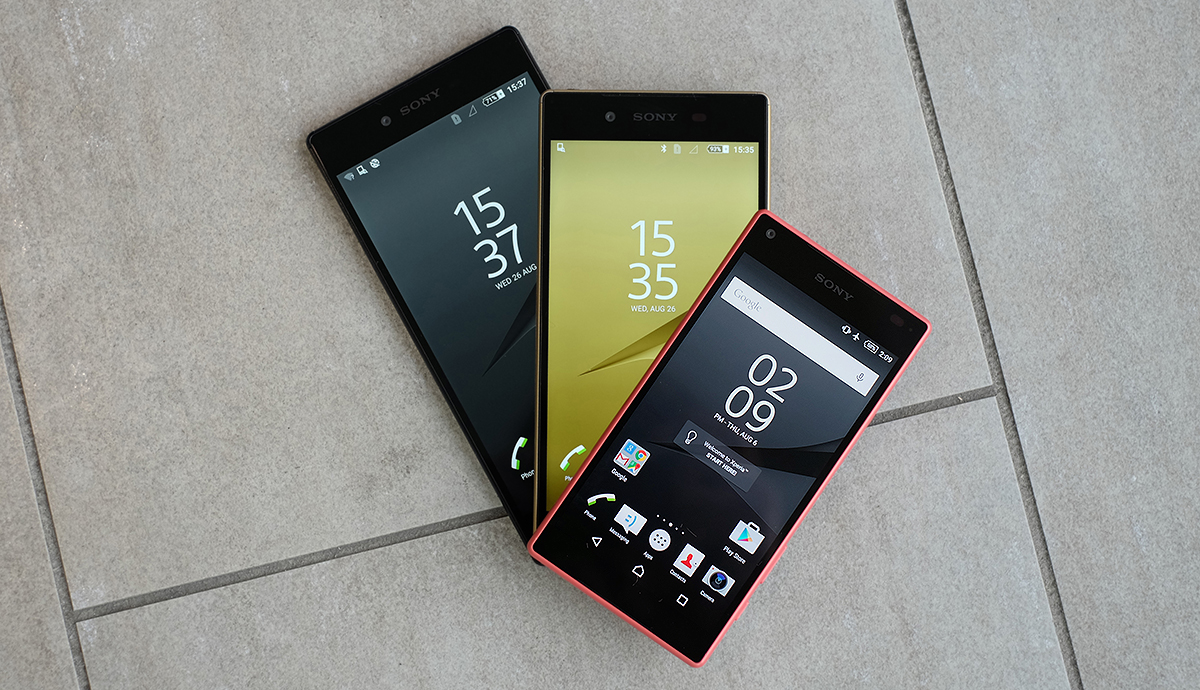
For what seems like the first time in ages, Sony is announcing a trio of flagship phones at the same time. From big to small, we've got the Z5 Premium, the Z5 and the Z5 Compact. The trio share many attributes, but thanks to one spec, the Premium is by far the most interesting.

The world's first 4K phone display


I'm totally besotted with the Premium's display. It's got a truly ridiculous, world-beating 5.5-inch 4K (3,840 x 2,160) panel, with rich colors and deep blacks. We'll need to spend more time than the few hours we've had with the new lineup to give a proper verdict, but right now we can say for sure that it looks great. I'm not sure I want a 4K display in my phone, but I am sure that the allure of an 806-ppi display will be enough to win some over. Sony's thrown down the gauntlet, and at least in pixel density, the Z5 Premium is the phone to beat.
Unfortunately, Sony's saved all of its new screen tech for the Premium, with the regular Z5 retaining the same 5.2-inch 1080p unit as the Z3 and Z3+, and the Z5 Compact getting a slightly larger -- 4.7 inches vs. the Z3 Compact's 4.6 inches -- but still 720p display.
Apart from their displays, the devices are almost identical.
As far as specs go, though, the displays are pretty much the only things distinguishing the Z5 Premium from the Z5 and Z5 Compact. All three have Qualcomm's Snapdragon 810 processor inside, up to 32GB of internal storage (expandable by microSD), high-res audio chips and "up to two-day battery life." That's a cute way Sony found to say "you only need to charge this one once a day." How they eke out that battery life differs of course, with the Premium having a 3,430mAh battery, the Z5 a 2,900mAh and the Z5 Compact a 2,700mAh. The only other differentiator is RAM: The Z5 Premium and Z5 have 3GB; the Z5 Compact only has 2GB.

The same, but different

Sony Xperia Z5
The Z5s' power buttons house fingerprint sensors.
If you've seen any Sony phone made in the last couple of years, I'm sure you've already noticed the Z5 family is a very familiar one. Sony's "OmniBalance" design theme has been knocking around since the Xperia Z1, and it's really difficult to get excited about: They're rectangular slabs with clean line; they're waterproof; and they're uncomplicated. That said, this is probably the tightest iteration on that theme. The Z5 Premium and Z5 both feel very polished, with carefully considered color schemes and materials. The Z5 Compact feels sturdier and a little chunkier, but not necessarily in a bad way.
The Z5 Premium is available in black, gold or chrome, all with a mirrored glass back, while the Z5 has white, black, gold and a subdued green, with a frosted glass back. Sony's clearly targeting the younglings with the Compact, especially with some of the bright and "fun" colors. It comes in the usual white and black, but also vibrant yellow and coral (pink) -- again with frosted glass at the back. Of course they're all different sizes too; The Z5 Premium has a 5.5-inch display and is 7.8mm thick; the Z5 has a 5.2-inch display and is 7.3mm thick; while the Compact has a 4.7-inch display and is 8.3mm thick.
Sony
The Z5 Premium in chrome makes for a very effective mirror.
I think the yellow Z5 Compact is probably my favorite of the bunch; the bright color wrapping around the edge of the black display frames the device really well. The green Z5 is also kinda classy looking, and it's a nice step away from the staid colors we're used to from flagships. Also, big shout out to the chrome Z5 Premium, which is essentially a mirror with a phone attached to the back. It's ostentatious; it's ridiculous; and it's impossible to keep clean, but I kinda love it.
So all these new Xperias are familiar, but changed. The same, but different. Those coming from a previous-generation Z will notice how nicely this latest bunch feels to hold, as well as some neat design additions. There's now a little "Xperia" wordmark etched into the phones' metallic sides, and the series' small circular power button is no more, replaced by an oval-shaped button that somehow squeezes in a tiny fingerprint reader.

Taking care of number one

Sony Xperia Z5
All three phones share the same camera setup.
Sony's new sensor is exclusive to Xperias, for now.
Sony's image sensors are everywhere. Of course you'll find them in the company's own smartphones, mirrorless and SLT cameras, but they're also in high-end Nikon and Fujifilm models. Not to mention flagship smartphones like the Samsung Galaxy S6 and LG G4. Put simply, they're considered some of the finest in the business, and one of the increasingly few areas that Sony is a market leader in. Not all sensors are created equal, though, and this time, Sony's keeping the best smartphone sensor for itself. All of the Z5s have a 1/2.3-inch Exmor RS 23-megapixel image sensor. It's brand-new, and Sony says it'll be exclusive to Xperias, at least for a while.
Sony sample image
Click image for original 7MB file. Shot by Sony at f/2.0, 1/2500s, ISO 40.
This fancy new sensor is backside illuminated and has embedded phase-detection pixels. It's housed in Sony's first mobile camera module with a closed-loop actuator, and in front of the sensor is a new six-element 24mm lens with a wide f/2.0 aperture. If you're unsure what all of this means, I'll break it down for you:
Sony says that, thanks to the phase-detection pixels, the Z5 family can autofocus in as little as 0.03 second, claiming it's the "world's fastest autofocus in a smartphone." All we can say is it's very quick. The actuator helps with this by swiftly moving the lens to focus, and because it's closed-loop, it'll also offer better image stabilization, especially for video. As you'd expect, all three will shoot movies in 4K, although evidently the Z5 Premium is the only one capable of playing footage back natively on the phone itself. Sony says the new sensor is capable of oversampling images (PureView style) for digital zoom "without loss of image quality." Take that claim with an ocean's worth of salt, of course, but the zoomed images definitely seemed good enough for a Facebook or Twitter share.
Sony Xperia Z5 camera sample
Click image for original 3MB file. Shot by Sony at f/2.0, 1/30s, ISO 250.
All of this adds up to... well, no one knows yet. What I can say is that Sony's sensors are the envy of the business; Sony's "unedited" sample images look fantastic; and, in my brief time with the Z5s, I took some quite pretty images that I'm sadly unable to share with you. But it's too early to say whether this new camera represents a huge leap forward, or even if it's at the front of the pack.

A fresh start

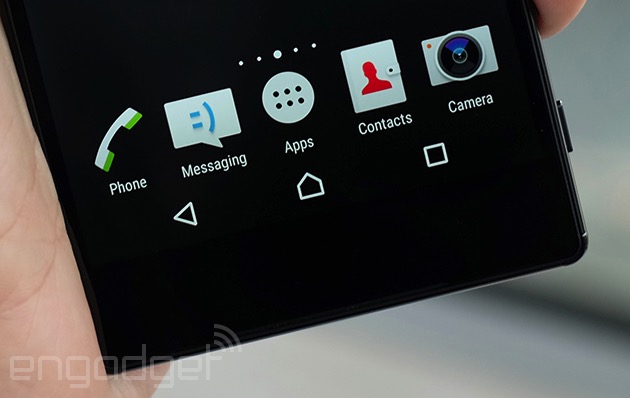
Sony Xperia Z5 icons
Although it's not quite stock, Sony has all but removed its Android skin.
On the software side, the Z5 family runs Android 5.1.1, and Sony says "stay tuned" about an Android M update. The good news for virtually everyone but the most die-hard of Sony fans, though? The company's Android skin is no more. Instead, the devices all run a virtually stock Android experience. Sure, there are some differences in iconography, but the general look-and-feel isn't too far from a Nexus device. That's a huge step forward from current Xperias, which feel like they're stuck in the past despite many of them actually being on the latest version of Android.
Google won't officially bake in fingerprint support to its OS until Android M is released this fall. Like other manufacturers, though, Sony already has things up and running. I wasn't able to test out the functionality myself, but the placement seems very natural, and I watched Sony staff unlocking their devices with various fingers and thumbs at a 100 percent success rate.

The big questions

Sony Xperia Z5
A close-up of the Xperia Premium's etched metal wordmark.
I'm pretty impressed with Sony's new lineup. But there are still three lingering questions that Sony needs to answer. First, there's the small matter of price. So far, we've got this from Sony: "Pricing will reflect the premium quality of the smartphone." Make of that what you will, but Sony isn't exactly known for producing budget devices. In the age of the OnePlus 2 and the Moto X Pure, you can get a lot of smartphone for a few hundred dollars.
Second is battery life and performance. The chip inside all three, the Snapdragon 810, has had some well-reported issues with overheating, and is not known to be very frugal when it comes to battery life. Couple that chip with a 4K display, and it's easy to question Sony's claim of "up to two-day" endurance when it comes to the Premium. The company points to its on-display memory (which effectively switches off the processor when the screen isn't moving), and other battery-saving tech as proof it can hit that target. Many will remain unconvinced until the phone's been properly tested.
Third, and perhaps most importantly for Sony's shot at a global success, is availability. The Z5 and Z5 Compact will be "globally" available in October, with the Z5 Premium following in November. But Sony has really struggled to persuade carriers to push its devices. That's especially true in the US, where sometimes it feels like Sony doesn't exist.
If a 4K display doesn't pique the US carriers' attention, nothing will.
You could argue that this is Sony's fault. Several generations of Xperias have come and gone, all of which looked pretty much the same, and none of which blew the competition out of the water. They've been solid phones, but plenty of companies make solid phones. Why should carriers put their weight behind Sony when Samsung et al. offer the same basic package? With iPhone season fast approaching, there's a real chance Sony could be left by the wayside again. At least with the Z5 Premium, Sony has clearly put everything it can into a single device, short of a new design. If the world's first 4K smartphone doesn't get the attention of AT&T, Verizon, Sprint and T-Mobile, nothing will.المصدر==Gadget=====
Sony Xperia Z5 family

السبت، 29 أغسطس 2015

Google's self-driving cars might be too good at braking for cyclists

Google's self-driving cars are cautious by design, but in at least one instance, it may be a bit too much. A cyclist posting on a road bike forum says that an encounter between themself and a self-driving car ended up with neither moving more than a few inches for a good two minutes. The cyclist apparently came to a stop at a four-way intersection moments after a Google car did, but the cyclist remained standing on their bike. As the car began to move forward, the cyclist also rolled forward slightly, causing the car to come to a halt. While trying to maintain balance on the bike, this back and forth keep going:
"I felt safer dealing with a self-driving car than a human-operated one."
"We repeated this little dance for about two full minutes, and the car never made it past the middle of the intersection," the cyclist writes. "The two guys inside were laughing and punching stuff into a laptop, I guess trying to modify some code to 'teach' the car something about how to deal with the situation."
Though it's obviously not the right behavior for a self-driving car, that's not a bad outcome for the encounter. Drivers often aren't very courteous of cyclists, but a well-made autonomous vehicle would have no option but to be careful and respectful. "The odd thing," the cyclist writes, is that "I felt safer dealing with a self-driving car than a human-operated one." Google may still have a lot of work to do, but that's the outcome it's looking for.

The encounter is said to have occurred in Austin, where Google very recently began a new set of self-driving car tests on public roads. In fact, it's encounters like this one that Google was looking for when it started up there. "From pedicabs to pickup trucks, Austin's streets will give our self-driving car some new learning experiences," Google said at the time. It's not surprising to hear that Google's cars continue to be cautious in their encounters with basically anything else on the road. Google recently started to report accidents that its cars have been in, and so far, Google says, every accident was the fault of another vehicle's human driverالمصدر===THE VERGE
.

الأحد، 23 أغسطس 2015

We asked Cortana some Halo questions - can you guess the answers?

If you've upgraded to Windows 10 of late, you'll have gained easy access to Cortana, a voice-activated personal assistant who bears a striking audio resemblance to Master Chief's see-through secretary/guidance councillor/probable love interest. That point's proven when you ask her Halo-themed questions - she's got a surprising repository of trivial/sassy responses to questions about the franchise she sprang from.
I've put together 15 of my favourite questions and answers to pose to my new trapped AI - but there's a twist. You have to guess which are the real responses, and which are dumb things I made up because I'd really like a job writing dialogue for text-to-speech robots.
Oh, and if you've found any particularly good secret questions I didn't ask, leave a comment - I want to bug her some more.Source==games  Radar+====

الجمعة، 21 أغسطس 2015

The best web browser of 2015: Firefox, Chrome, Edge, IE, and Opera compared


We put the screws to all five modern browsers, testing them in all manner of scenarios. If you're looking for a fast, efficient, convenient browser, we've found two that we think you'll like.

The best browsers go beyond benchmarks, racing through real-world webpages as well as canned routines. They’re easy to set up, flexible and extensible, and connect other devices and services into an ecosystem. 
Look, throwing a few benchmarks at a browser just doesn’t cut it any more. Just as you expect us to test graphics cards against the latest games, we think your browsers should be tested against a collection of live sites. Can they handle dozens of tabs at once? Or do they shudder, struggle, and crash, chewing through your PC’s processor and memory? 
To pick a winner, we put Google Chrome, Microsoft’s Edge and Internet Explorer, Mozilla Firefox, and Opera to the test, barring Apple’s abandoned Safari for Windows. We used the latest available version of each browser, except for Firefox, which upgraded to Firefox 40 late in our testing. And we also tried to look at each browser holistically: How easy was each to install and set up? Does Opera make it simple to switch from Chrome, for example?
microsoft edge bing
For 2015, we have a newcomer: Microsoft’s Edge browser, which has been integrated into Windows 10.
You’ve already seen part of our tests, where we showed you how much of an impact enabling Adobe Flash can have on your system. Disabling or refusing to load Flash can seriously improve performance—some sites, like YouTube, have begun to transition to less CPU-intensive HTML5 streams. Still, other readers pointed out that they simply need to run Flash on their favorite sites. That’s fine—we tested with and without Flash, so you’ll have a sense for which browser performs best, in either case.
Oh, and Microsoft: We found that your new Edge browser isn’t quite as fast as you make it out to be. (Sorry!) But it still demonstrated definite improvement over Internet Explorer.

The benchmark numbers favor Chrome and Firefox

We do consider benchmarks to be a valuable indicator of performance, just not a wholly defining one. Still, they’re the numbers that users want to see, so we’ll oblige. We used a Lenovo Yoga 12 notebook with a 2.6GHz Intel Core i7-5600U inside, running a 64-bit copy of Windows 10 Pro on 8GB of memory as our test bed.
We tested Chrome 44, Windows 10’s Edge 12, Firefox 39, Internet Explorer 11, and Opera 31 against two popular (though unsupported) benchmarks—Sunspider 1.0.2 and Peacekeeper—just for reference purposes. But we’d encourage you to pay attention to the more modern benchmarks, including Jet Stream,  Octane 2.0, Speedometer, and WebXPRT. The latter two are especially useful, as they try to mirror actual interaction with web apps. We also tested using Oort Online’s graphics benchmark as well as the standardized HTML5test—which is not so much a benchmark, but an evaluation of how compatible a browser is with the HTML5 standard for Web development.
From our testing, Chrome and Firefox topped the Speedometer and WebXPRT tests, respectively. Perhaps unsurprisingly, Google was the fastest browser under the Google-authored Octane 2.0 benchmark. But Microsoft’s Edge led the pack in the Jet Stream benchmark—which includes the Sunspider tests, which Edge led as well. (For all of the benchmarks, a higher number is better; the one exception is Sunspider, which records its score in the time it took to run.)
browser testing benchmarks 1st set
Google Chrome and Mozilla Firefox do well here. (A higher result is better, except for the Sunspider benchmark.)
What’s surprising about Edge is that it led the pack in the Jet Stream benchmark, but fell way behind on Speedometer, only to record a quite reasonable score in WebXPRT. (Microsoft claims that Edge is faster than Chrome in the Google-authored Octane 2.0 benchmark as well, but our results don’t indicate that.)
Chrome flopped on the Sunspider test; the only test Firefox failed equally miserably in was the Oort Online benchmark, which draws a Minecraft-like landscape using the browser.
browser testing benchmarks 2nd set
For whatever reason, I noticed some graphical glitches as Edge rendered the Oort landscape, including problems drawing a shadow that slid across the bay in the night scene. But Oort proved even more problematic for Firefox, rendering “snow” as flashing lights and rain as a series of lines. (We’ve included the test result, but take it with a grain of salt.) Internet Explorer 11 simply couldn’t run the Oort benchmark at all.
We also included the HTML5test compatibility test, which measures how compatible each browser is with the latest HTML5 Web standards. Although some developers focus extensively on each browser’s score, even the test developer isn’t too concerned:
 And the only one that fails that test, of course, is the semi-retired Internet Explorer 11.
What does all this mean? It doesn’t indicate a clear win for any specific browser, including Chrome. Based on our benchmark tests, many of the browsers will handle the modern web just fine.
Next page: Real-world testing and "the convenience factor."
arrow up
Amazon Shop buttons are programmatically attached to all reviews, regardless of products' final review scores. Our parent company, IDG, receives advertisement revenue for shopping activity generated by the links. Because the buttons are attached programmatically, they should not be interpreted as editorial endorsements.Source==pc world==

Google says Project Ara didn't fail drop test, better camera and battery coming

Google's got truly brilliant engineers in its ranks, but some could use some sharpening of their comedic skills. Today the company tweeted a clarification saying that its Project Ara modular smartphone didn't actually fail any drop test. The Ara team is still reworking how modules attach to one another, but the change apparently wasn't inspired by Ara breaking apart; Google simply found a better way. "We have been configuring a new solution," the Ara group tweeted. "It's better too."
Project Ara is also getting a better camera and longer battery life, according to two other tweets posted today. Back at Google I/O, the company wowed its keynote crowd by assembling a functioning Ara model right on stage and snapping a photo. But the quality of that image left something to be desired.
Project Ara camera
On Monday, Google revealed that it was backing off plans to conduct a Project Ara pilot in Puerto Rico later this year. The company is now targeting a 2016 introduction and says it's looking into "a few locations" in the US where Ara could make its consumer-facing debut. Project Ara team has promised more details on what's to come "soon."Source==THE VERGE

Yahoo Weather warns you about rain in time to find an umbrella

Weather apps are quite handy, and now Yahoo's mobile software is even more helpful. The app will send you an alert 15 minutes before rain or snow is expected to start so you have enough time to prepare. The new feature offers warnings similar to Dark Sky's weather info. That app takes readings from the barometric sensors in users' iPhones, though. What's more, Yahoo says its Weather software is more accurate too, with the ability to zoom in on small areas should the need arise. Of course, you want to take a slightly different approach to getting your forecast, you could always go the route of an aspiring meteorologist..Source==engadget===

Google is doubling down on biotech


sergey brinRe/code, Asa MathatGoogle co-founder Sergey Brin
Google is doubling down on biotech.
The company is turning the team that develops smart contact lenses and other healthcare initiatives into a full-fledged, standalone company rather than a lab project.
The life sciences group will "graduate" from the Google X labs and become its own separate company under the new Alphabet corporate structure, Google co-founder Sergey Brin said on Thursday.
Andy Conrad, a molecular biologist who joined Google in 2013, will be the CEO of the new company, Brin said.
"While the reporting structure will be different, their goal remains the same. They’ll continue to work with other life sciences companies to move new technologies from early stage R&D to clinical testing—and, hopefully—transform the way we detect, prevent, and manage disease," Brin explained. 
The move could signal that Google views some of the life science initiatives as promising enough to be their own commercial entity.
The move follows Google's announcement last week of a massive overhaul of its corporate structure. What was once Google will become a holding company called Alphabet, made up of several individual companies including Google's traditional Web businesses (search, maps, YouTube, Android, and so on), Nest (Google's home appliances group) and Fiber (Google's high speed Internet delivery service). 
Google X, the research lab for projects such as self-driving cars and airborne wind turbines, will also become a separate subsidiary within Alphabet.Google smart contact lensGoogleGoogle's smart contract lens
The life sciences group, which will now be pulled out of X, includes a nanodiagnostics platform, a cardiac and activity monitor, and the Baseline Study, Brin noted in the post.
The Baseline Study is an effort by Google to collect genetic and molecular information from hundreds of people to create a picture of what a healthy human body looks like. 
With the move, Alphabet will actually have two health-focused companies under its flag: the new life sciences company (which presumably will get a catchier name at some point) and Calico, a separate company that Google created in 2013 that is focused on health issues related to aging.
Here's Brin's full Google+ post on the life sciences change:
3 years ago we embarked on a project to put computing inside a contact lens – an immensely challenging technical problem with an important application to health.  While I am delighted at the progress that project has made, I could not have imagined the potential of the initiative it has grown into – a life sciences team with the mission to develop new technologies to make healthcare more proactive.  The efforts it has spawned include  a nanodiagnostics platform, a cardiac and activity monitor, and the Baseline Study.
It’s a huge undertaking, and I am delighted to announce that the life sciences team is now ready to graduate from our X lab and become a standalone Alphabet company, with Andy Conrad as CEO.  While the reporting structure will be different, their goal remains the same. They’ll continue to work with other life sciences companies to move new technologies from early stage R&D to clinical testing—and, hopefully—transform the way we detect, prevent, and manage disease.  

   
The team is relatively new but very diverse including software engineers, oncologists, and optics experts.  This is the type of company we hope will thrive as part of Alphabet and I can’t wait to see what they do next.

الخميس، 20 أغسطس 2015

Vuelta a España: Riders question conditions of dirt bike path team time trial course | Cyclingnews.com

Some of the riders in this year’s Vuelta a España had a shock on Thursday morning when they studied the route of Saturday’s opening team time trial and realised that sections of the 7.4km seafront course are on a sand and dirt covered bike path, with the finish on the Levante beach in Marbella apparently reached via a raised platform.
The official race manual showed the 7.4km course starting on a narrow sea wall in Puerto Banus and hugging the seafront but does not show the conditions of the surface or the platform finish on the beach.
Chris Froome was one of the first to raise concerns about safety, after realising that he and his teammates will be expected to race at close to 50km/h on the dirt track. The Tour de France winner posted a collage of photos from Team Sky’s morning recon ride, showing how wheels struggled on the dirt surface and revealing a wooden decking section.
Froome also reached out to the Cyclistes Professionnels Associés representitives for the Vuelta Iker Camaño Jose Luis De Santos, asking: “Any thoughts?”

Other riders were not so diplomatic, with Australian Movistar rider Rory Sutherland tweeting several photos of the dirt and sandy surface, asking: “is the @UCI_cycling serious that this is acceptable? Union???”
Froome’s teammate Nicolas Roche also vented his disappointment about the course by tweeting a photo of his rear wheel carving a groove into the dirt. He asked: “Vuelta ttt!!!! Are you joking????”
Thomas De Gendt (Lotto Soudal) tweeted a photo of a long section of rubber mats that also seemed part of the team time trial course.
Despite the questons about the road surface and safety, the race organisers seem happy with the planned route. The official Vuelta Twitter account posted a photo of the narrow finish platform, writing: “Look at the finish line of the first stage of #LV2015 in Playa de Levante! Everything is ready!”